
Pure magnesium glycinate.
Zero oxide.
Full glycine.
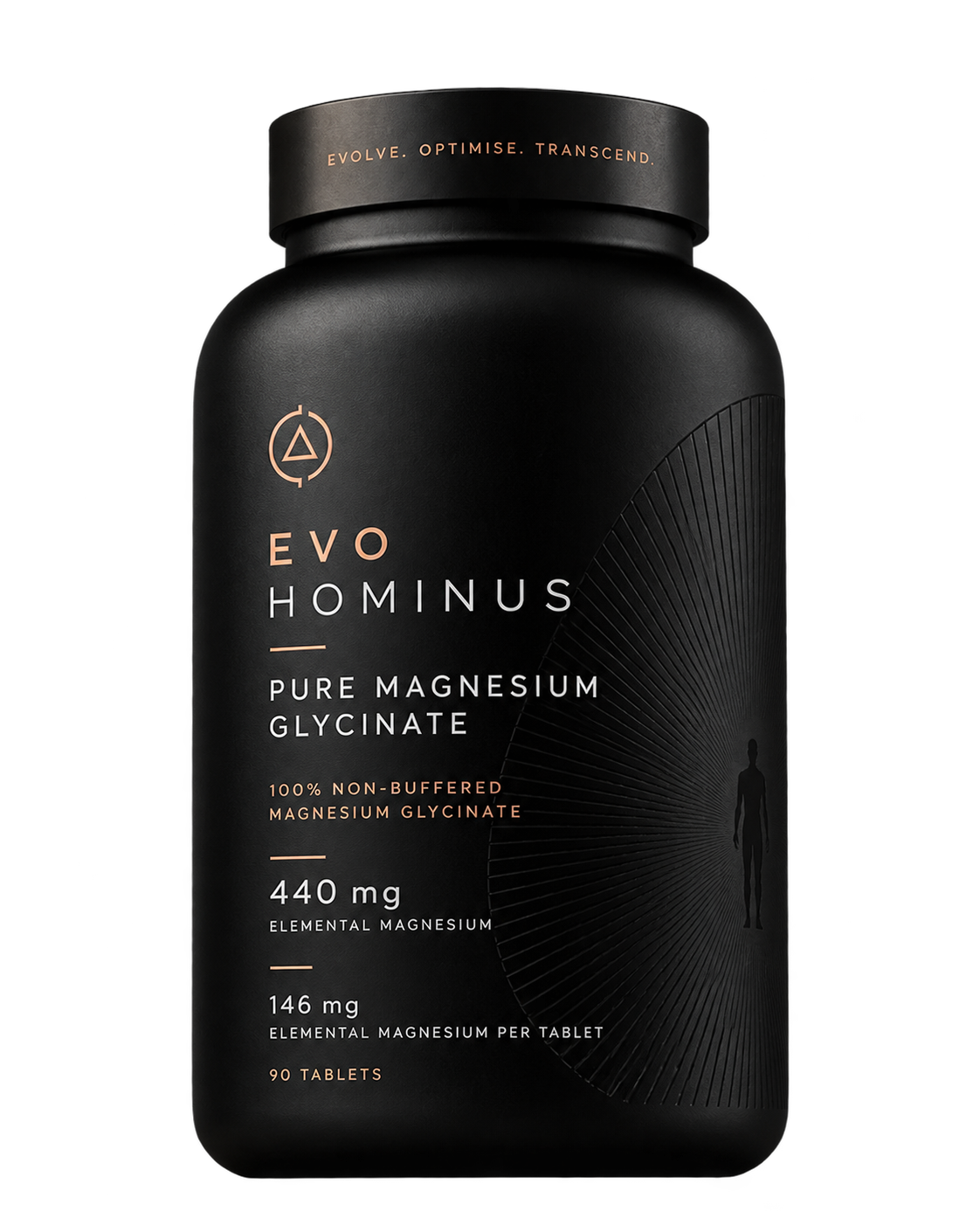
440 mg of elemental magnesium in every serving, from 100% non-buffered magnesium glycinate — fully reacted magnesium bisglycinate with no magnesium oxide mixed in. Every molecule also carries glycine, so each serving brings about 2.7 g of glycine, the calming amino acid studied for sleep quality. Three tablets a day.
Vegetarian tablets · 0 mg magnesium oxide · 12% magnesium — the chelate math checks out
Magnesium glycinate for sleep, stress and recovery.
Late nights, early meetings, hard training, a mind that won’t switch off. Magnesium helps with all of it, and the glycinate form brings a second helper along — glycine.
A better evening wind-down
Magnesium bisglycinate is the exact form tested in a 2025 trial of 155 adults with poor sleep. It improved their insomnia scores more than a placebo within four weeks.1 Each serving also carries about 2.7 g of glycine, close to the 3 g taken before bed in human sleep-quality studies.2,3
Magnesium bisglycinate · GlycineCalm mind, steady nerves
Magnesium contributes to normal psychological function and to the normal functioning of the nervous system.4 In stressed adults with low magnesium, 300 mg a day reduced how stressed they felt over eight weeks.5 One serving here gives 440 mg.
MagnesiumMuscle function & recovery
Magnesium contributes to normal muscle function and to electrolyte balance.4 In a small trial, magnesium glycinate at 350 mg a day reduced soreness after hard training and improved how recovered people felt.6
Magnesium bisglycinateLess tiredness, steadier energy
Magnesium contributes to the reduction of tiredness and fatigue and to normal energy-yielding metabolism.4 In adults kept on short sleep, 3 g of glycine at bedtime reduced next-day sleepiness and fatigue.3
Magnesium · GlycineBones, teeth & protein use
Magnesium contributes to the maintenance of normal bones and teeth and to normal protein synthesis4 — useful whether you lift weights, run, or simply want to age well.
MagnesiumGentle on your stomach
Magnesium bisglycinate is partly absorbed through the gut’s amino-acid pathways, and in a clinical study it was better tolerated than magnesium oxide.7 Non-buffered means no oxide at all — the form most linked to loose stools.
Magnesium bisglycinateClaim wording follows the authorised nutrient-function claims of EU Regulation 432/2012 for magnesium. Glycine has no authorised claim, so we describe it through the human studies, with their details in the “About the studies” box at the bottom of this page.
Magnesium bisglycinate: one ingredient, nothing hiding.
Three tablets give you 3,667 mg of fully reacted magnesium bisglycinate. Tap a row to see what it does. Doses are per three-tablet serving.
Magnesium Bisglycinate100% fully reacted, non-buffered — 3,667 mg440 mg
GlycineCarried by the magnesium chelate~2.7 g
Other ingredientsListed in full, as on the label—
Pure chelate means the full glycine dose.
Glycine only comes with magnesium that is properly chelated. When a product is “buffered” with magnesium oxide, part of its magnesium arrives with no glycine at all.
Take a typical buffered tablet listing 2,000 mg of “magnesium glycinate” and 440 mg of magnesium. To reach that number, roughly half its magnesium has to come from oxide — leaving only about 1.4 g of glycine. Pure Magnesium Glycinate gives the same 440 mg of magnesium with about 2.7 g of glycine, all of it from the chelate.1,2
Non-buffered vs buffered magnesium glycinate, side by side.
Measured against a typical “buffered” magnesium glycinate on the shelf.
Three tablets. Mostly in the evening.
Simple enough to keep doing
- Take three tablets a dayOne with dinner and two about an hour before bed works well, or all three in the evening. Take them with water, and with food if your stomach is sensitive.
- Women: two tablets fit your allowanceIndia’s daily magnesium allowance is 440 mg for men and 370 mg for women. Two tablets give about 293 mg.11
- Space it from certain medicinesTake it at least two hours apart from tetracycline or quinolone antibiotics, bisphosphonates and thyroid medication.14 Don’t exceed three tablets a day; if your stools get loose, drop to two.
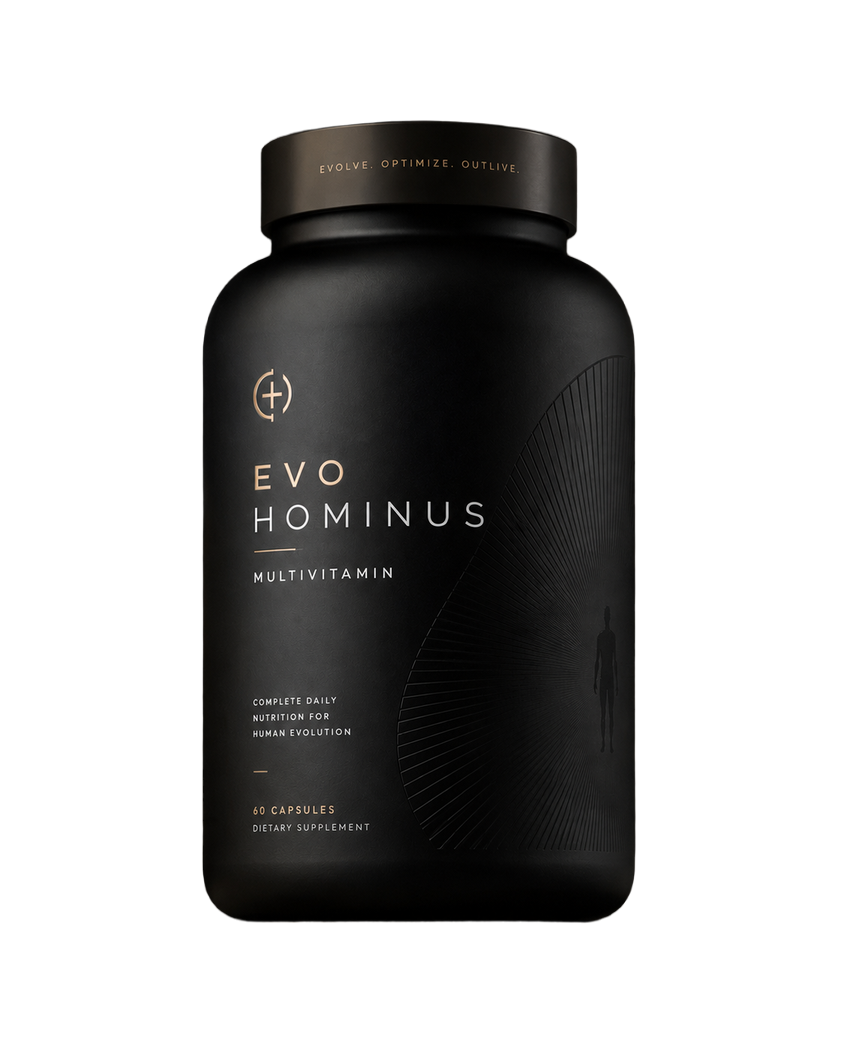
Evo Hominus™ Bioactive Multivitamin
Twelve vitamins in active forms, one capsule at breakfast. It’s designed to sit alongside Pure Magnesium Glycinate at night — vitamins in the morning, magnesium in the evening.
Coming soonHow to spot unbuffered magnesium glycinate on any label.
- Do the math. Divide the magnesium by the glycinate weight. About 12–14% means a true chelate. 18% or more means oxide has been added.
- The word “buffered”. Also watch for “chelate blend” or “glycinate complex”. Look for “fully reacted”, “non-buffered” or “unbuffered”.
- “Magnesium oxide” in the ingredients. It’s cheap and was only about 4% absorbed in one study.9 In a glycinate product, it means buffering.
- The word “elemental”. “2000 mg magnesium glycinate” is compound weight. Check how many milligrams of actual magnesium you get.
- Many forms, no amounts. “Triple” or “multi-form” magnesium without a per-form amount hides how much is oxide.
- “Proprietary blend”. If the doses are hidden, you can’t tell what you’re taking.
Pure Magnesium Glycinate, answered plainly.
What is non-buffered magnesium glycinate?
How can I tell if a magnesium glycinate is non-buffered?
Which magnesium glycinate supplements in India are non-buffered?
Is magnesium glycinate the same as magnesium bisglycinate?
How much glycine does it contain, and why does it matter?
Why three tablets a day?
Is 440 mg of magnesium a day safe?
When is the best time to take it?
Will it help me sleep?
Will it upset my stomach?
Can I take it with other supplements or medicines?
Is it vegetarian? What about allergens?
How soon will I notice a difference?
Does Evo Hominus™ make other magnesium products?
Be first to get Pure Magnesium Glycinate.
Join the Evo Hominus™ waitlist for founding-batch pricing, the lab report for batch 001, and first-day shipping across India.
- The 2025 sleep trial gave 250 mg of magnesium a day as bisglycinate to 155 healthy adults with poor sleep; this product gives 440 mg. The improvement was modest, and larger in people who ate less magnesium.1
- The glycine sleep studies gave 3 g of pure glycine before bed. They were small (11 people in the sleep-lab study) and funded by a glycine maker.2,3 The body-cooling pathway was mapped in rats.12 Here the glycine is carried by the magnesium chelate rather than taken on its own.
- The stress trial used a different magnesium salt in adults with low blood magnesium.5 The muscle-soreness trial was in 22 young adults over 10 days, at 350 mg a day.6
- The stomach-tolerance study was in 12 people after bowel surgery: overall absorption was similar to oxide, and the chelate absorbed better in the four people who absorbed oxide worst.7 The 60-day comparison used an amino-acid chelate of magnesium, not specifically bisglycinate.8
- The “buffered” glycine example assumes pure bisglycinate is about 14% magnesium and magnesium oxide about 60%; real buffered products vary.
- For supplements, Europe sets 250 mg and the US 350 mg of magnesium a day as levels to avoid loose stools in everyone. India’s ICMR-NIN allowance is 440 mg for men and 370 mg for women, from all sources.11
Studies behind this product
The numbered notes throughout this page point here. Where research used a different dose or form, we’ve said so in the “About the studies” box and in the note beside each study.
- Schuster J, Cycelskij I, Lopresti A, Hahn A. Magnesium bisglycinate supplementation in healthy adults reporting poor sleep: a randomized, placebo-controlled trial. Nat Sci Sleep. 2025;17:2027–2040. PMID 40918053 — 250 mg elemental magnesium/day as bisglycinate, n=155, 4 weeks.
- Yamadera W, Inagawa K, Chiba S, Bannai M, Takahashi M, Nakayama K. Glycine ingestion improves subjective sleep quality in human volunteers, correlating with polysomnographic changes. Sleep Biol Rhythms. 2007;5:126–131 — 3 g glycine before bed, n=11, industry-sponsored.
- Bannai M, Kawai N, Ono K, Nakahara K, Murakami N. The effects of glycine on subjective daytime performance in partially sleep-restricted healthy volunteers. Front Neurol. 2012;3:61. PMID 22529837 — 3 g glycine at bedtime, sleep restricted by 25%.
- European Commission. Regulation (EU) No 432/2012 establishing a list of permitted health claims made on foods (magnesium). Official Journal of the European Union. 2012;L136:1–40.
- Pouteau E, et al. Superiority of magnesium and vitamin B6 over magnesium alone on severe stress in healthy adults with low magnesemia: a randomized, single-blind clinical trial. PLoS One. 2018;13(12):e0208454 — 300 mg magnesium/day, n=264, 8 weeks.
- Reno AM, et al. Effects of magnesium supplementation on muscle soreness and performance. J Strength Cond Res. 2022;36(8):2198–2203. PMID 33009349 — 350 mg/day magnesium glycinate, n=22, 10 days.
- Schuette SA, Lashner BA, Janghorbani M. Bioavailability of magnesium diglycinate vs magnesium oxide in patients with ileal resection. JPEN J Parenter Enteral Nutr. 1994;18(5):430–5. PMID 7815675 — n=12.
- Walker AF, Marakis G, Christie S, Byng M. Mg citrate found more bioavailable than other Mg preparations in a randomised, double-blind study. Magnes Res. 2003;16(3):183–91. PMID 14596323 — 300 mg/day for 60 days, n=46.
- Firoz M, Graber M. Bioavailability of US commercial magnesium preparations. Magnes Res. 2001;14(4):257–62. PMID 11794633 — magnesium oxide fractional absorption about 4%.
- EFSA AFC Panel. Opinion on certain bisglycinates as sources of copper, zinc, calcium, magnesium. EFSA Journal. 2008;718:1–26.
- ICMR-NIN. Nutrient Requirements for Indians, 2020 (magnesium RDA: 440 mg men, 370 mg women); FSSAI Health Supplements, Nutraceuticals… Regulations, 2022.
- Kawai N, Sakai N, Okuro M, et al. The sleep-promoting and hypothermic effects of glycine are mediated by NMDA receptors in the suprachiasmatic nucleus. Neuropsychopharmacology. 2015;40(6):1405–16. PMID 25533534 — animal (rat) study.
- Blancquaert L, Vervaet C, Derave W. Predicting and testing bioavailability of magnesium supplements. Nutrients. 2019;11(7):1663. PMID 31330811 — products relying on magnesium oxide ranked lowest for absorption.
- NIH Office of Dietary Supplements. Magnesium — Fact Sheet for Health Professionals (interactions with medications).
Nutrition Science Hub
Glycinate vs citrate vs oxide
Which magnesium forms absorb, which don’t, and how to read the label.
Read the guide → Magnesium in IndiaAre you low on magnesium?
The everyday signs, who’s most at risk, and how much you really need.
Read the guide → Evening wind-downTrouble switching off at night
Why the mind stays busy after dark, and the nutrients linked to a calmer evening.
Read the guide →